
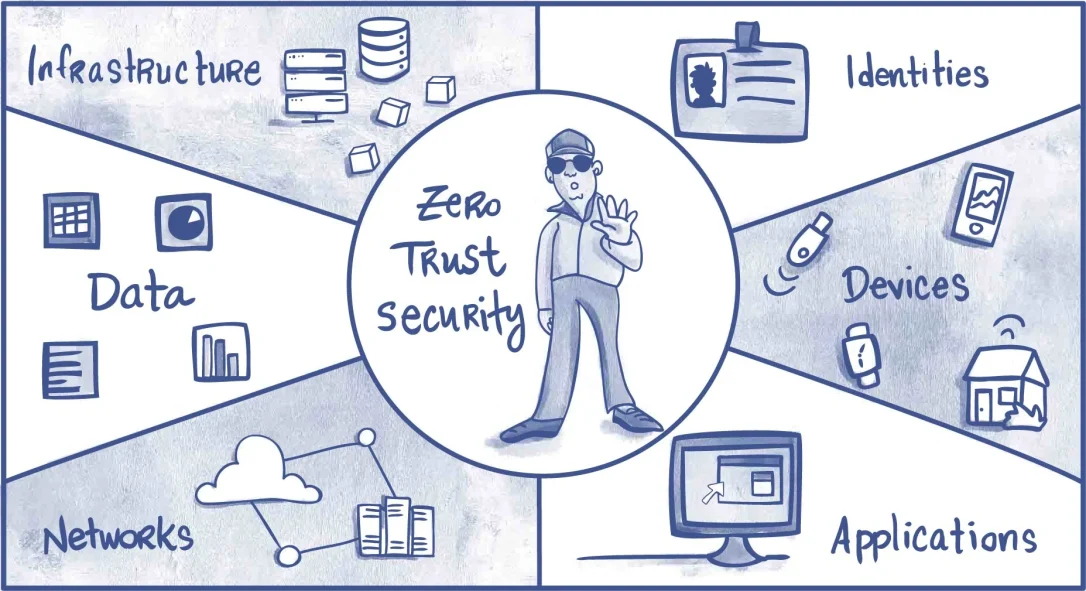
If you’ve ever visited a high-security facility—think the Pentagon, a federal courthouse, or even a secure data center—you already understand Zero-Trust security, whether you realize it or not.
You don’t just walk in because someone recognizes you. You badge in. You show identification. You’re escorted. And even after all that, you’re only allowed into the areas you’re authorized to access.
No one takes this personally. It’s not about mistrust. It’s about protecting sensitive information and critical operations.
That same philosophy is what Zero-Trust security is meant to bring to law firms and CPA firms—especially those with 10 to 50 people who handle confidential client data every single day.
Zero-Trust Is Not About Distrust
The name “Zero-Trust” is unfortunate. It sounds extreme, even hostile, which is why many firm owners instinctively recoil when they hear it.
Zero-Trust does not mean you don’t trust your staff. It does not mean you assume employees are careless or malicious. And it certainly does not mean turning your IT environment into a maze of logins and approvals that slow everyone down.
What Zero-Trust really means is that access is verified rather than assumed. Instead of saying, “They’re on our network, so they must be safe,” Zero-Trust quietly confirms identity, device, and permission every time someone tries to access systems or data.
It’s a shift from blind trust to reasonable verification—something professional firms already practice in every other area of risk management.
Why Law Firms and CPA Firms Are Targeted
Small and mid-sized professional firms sit in a dangerous sweet spot for cybercriminals.
You hold highly sensitive data. You have access to financial systems, tax records, escrow accounts, and legal strategies. You’re governed by ethical and regulatory obligations. And historically, many firms still rely on flat networks and password-based security models.
Attackers know this.
Most breaches today don’t start with sophisticated hacking. They start with a phishing email, a compromised password, or a trusted user accessing the system from an untrusted device. Once inside, traditional networks allow attackers to move freely, often undetected, until real damage is done.
Zero-Trust is designed to stop that lateral movement and limit the blast radius of an incident.
Bringing the High-Security Facility Model Into IT
In a secure facility, security doesn’t end at the front door. Being inside the building doesn’t grant unrestricted access. Every door, every hallway, every secured area enforces its own rules.
Zero-Trust applies the same logic digitally.
Access decisions are based on who the user is, what device they’re using, and whether their request makes sense given their role and behavior. A staff member working from a secured firm laptop during business hours looks very different from the same login coming from an unmanaged device at 2 a.m.
The goal isn’t to create friction. The goal is to make sure the right people have the right access at the right time—and to quietly stop everything else.
What Zero-Trust Looks Like in a Small Firm
When implemented correctly, Zero-Trust in a 10–50 person firm is surprisingly practical.
User identity becomes the primary security boundary rather than the office firewall. Multi-factor authentication is used to protect critical systems, not as a nuisance but as a safety net. Devices are evaluated for security posture, so firm-managed systems are trusted differently than personal ones. Access is limited based on role, reducing unnecessary exposure. And security decisions are continuously reevaluated rather than assumed forever.
When done right, most users barely notice it. Like seatbelts or airbags, it stays out of the way—until it matters.
The Compliance Reality
For law firms and CPA firms, cybersecurity isn’t just an IT concern. It’s a business and compliance issue.
Regulations and standards such as the FTC Safeguards Rule, IRS Publication 4557, and evolving state privacy laws all point toward the same expectation: firms must take reasonable steps to protect sensitive information.
In the event of a breach, the question is rarely “Were you perfect?” It’s “Did you take reasonable, defensible precautions?”
Zero-Trust provides a framework for answering that question with confidence.
Zero-Trust Is a Strategy, Not a Product
One of the most common mistakes firms make is assuming Zero-Trust is something you buy.
It isn’t a firewall, a single software platform, or a checkbox on a compliance list. It’s a strategy that combines technology, process, and ongoing oversight.
That’s why many firms feel overwhelmed when they try to tackle it alone. Without a clear understanding of current risks, efforts tend to become fragmented, expensive, and frustrating.
Ready to See Where Your Firm Really Stands?
Zero-Trust isn’t something you implement by guessing — and it’s definitely not something you start by buying tools.
The smartest first step is understanding your current risk posture: where your real exposures are, how an attacker would view your environment, and which improvements will actually reduce risk without disrupting your firm.
That’s exactly what our Cybersecurity Assessment is designed to do.
This assessment provides:
- An independent, practical review of your current environment
- Insight into how attackers could exploit gaps today
- Clear, prioritized recommendations tailored to law firms and CPA firms
There’s no obligation and no technical jargon — just clarity.
👉 Request your Cybersecurity Assessment here:
https://itfusiontech.com/free-network-assessment/
Because Zero-Trust doesn’t start with technology.
It starts with visibility.