
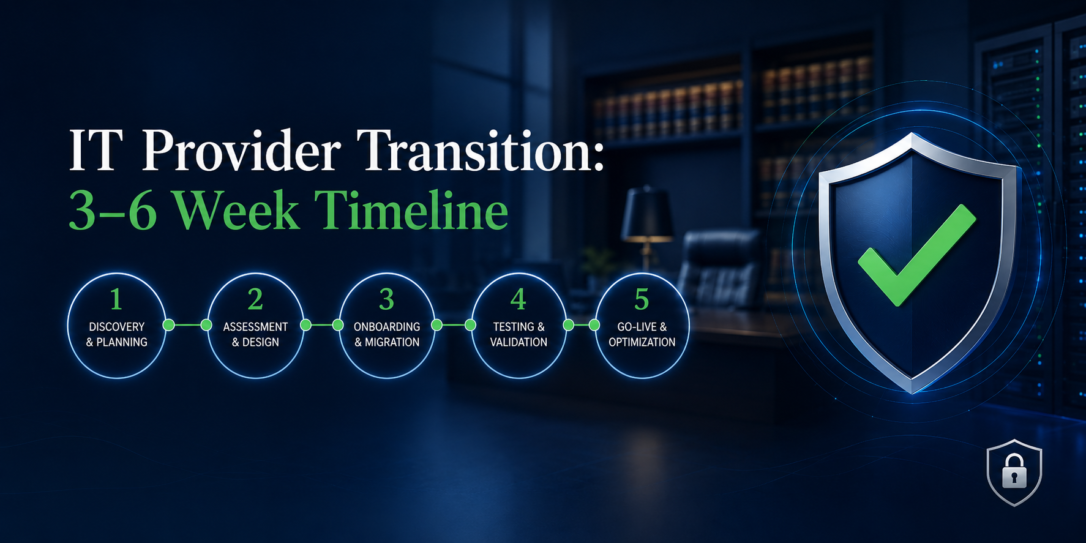
A law firm can switch IT providers in 3–6 weeks with minimal disruption when you plan properly. The transition focuses on installing new management tools, reconfiguring backup and monitoring infrastructure, replacing your firewall with a standardized compliance-ready model, and establishing documented processes.
IT Fusion has completed 20+ successful IT provider transitions for South Florida law firms. Unlike reactive “emergency migrations,” a planned switch to a new IT provider lets you upgrade your security posture, audit compliance policies, clean up undocumented configurations, and establish formal procedures—all without replacing existing workstations or servers.
Most importantly, your actual business disruption stays minimal. Staff notice little to no change in their day-to-day work.
Phase 1: Discovery, Compliance Audit & Assessment (Weeks 1–2)
The first step when you switch IT providers is comprehensive discovery. We document all workstations, servers, network equipment, and peripherals. Next, we assess current hardware age, condition, and specifications to identify which devices can continue under new management versus which may need replacement in the coming year.
Meanwhile, we audit all software licenses and installed management/monitoring tools to understand your current infrastructure. Additionally, we map all third-party software dependencies—your practice management system, document management platform, billing software, and any custom integrations that connect these systems.
Compliance Policy Assessment (The Real Foundation of Compliance)
Here’s where most IT provider transitions fall short: technical infrastructure matters far less than the policies and procedures that govern it. When you’re ready to switch IT providers, compliance assessment must come first.
Specifically, we conduct a thorough compliance policy assessment that includes:
- Access Control Policies: We review who has administrative rights, why they have those rights, and whether this access is formally documented and regularly audited. Frequently, we discover staff with unnecessary elevated privileges—a significant compliance and security risk.
- Password Management Procedures: Our team evaluates whether password standards are documented and enforced across all systems. This includes complexity requirements, change frequency, multi-factor authentication implementation, and whether these policies are actually being followed.
- Backup and Disaster Recovery Procedures: We audit your current backup strategy and, critically, whether backups are tested regularly. We look for documented recovery time objectives (RTOs) and recovery point objectives (RPOs). In our experience, many firms have backups running but have never verified they can actually restore data when needed.
- Incident Response Procedures: Our assessment checks whether formal procedures exist for handling security incidents. This includes defining who should be contacted, notification timelines, escalation criteria, and whether the procedure has been tested.
- Data Retention and Deletion Policies: We review whether your firm has documented policies aligned with ABA rules and matter requirements. This includes how long closed matter files are retained and how sensitive data is securely deleted.
- Security Awareness Training: Finally, we evaluate whether staff receive ongoing security training, how often, and what topics are covered. We check whether training completion is tracked.
Planning Deliverables from Your IT Provider Switch
Once discovery concludes, we create several key deliverables:
- Hardware assessment report with multi-year recommendations
- Compliance policy gap analysis identifying what’s missing, what’s outdated, and what needs enforcement
- List of third-party vendors requiring notification
- Inventory of old management tools that need removal
- Detailed cutover timeline for switching IT providers
- FTC Safeguards and ABA compliance checklist (baseline for new infrastructure)
Time commitment: Expect 6–8 hours onsite (including interviews with managing partner and office manager) plus 3–4 hours reviewing compliance documentation.
Phase 2: New Management Infrastructure Setup & Compliance Policy Design (Weeks 2–3)
Before any cutover, we deploy the new management infrastructure. When you switch IT providers, this phase ensures your new provider’s tools are properly configured and tested before they go live.
New Tools Installation During Your Provider Transition
Specifically, we install:
- Management console for centralized IT monitoring across all devices
- Backup and disaster recovery tools with automated testing capabilities
- SIEM (Security Information & Event Management) infrastructure for centralized security logging
- EDR (Endpoint Detection & Response) agent distribution to all workstations and servers
- Security logging and alerting baseline to establish what normal looks like
Firewall Planning for Your IT Provider Switch
Next, we audit your current firewall configuration and security policies, then design a new standardized firewall built specifically for law firm compliance requirements. This firewall replaces your existing one and serves as the central point for all security policies, threat detection, and compliance logging when you switch IT providers.
Compliance Policy Development When Switching IT Providers
Rather than just install tools, we design the policies that will govern their use when you switch IT providers:
- Access Control Policies: We draft formal procedures defining who gets access, how access is approved, and how access is reviewed quarterly. Importantly, we establish that admin rights require documented justification and regular review.
- Backup Testing Procedures: Additionally, we define a backup testing schedule (typically monthly) with recovery verification and documentation requirements.
- Incident Response Procedures: We create formal incident response workflows defining the reporting chain, external notification timelines based on severity, and escalation criteria.
- Data Retention and Secure Deletion: We document procedures aligned with ABA retention rules, specifying how long matter files are kept and how data is securely deleted when retention periods expire.
- Password Management Standards: Furthermore, we establish complexity requirements, change frequency, and multi-factor authentication for privileged accounts.
- Security Awareness Training Plan: Finally, we schedule ongoing training (typically quarterly), define topics, and establish completion tracking.
Compliance Checkpoint: Your new infrastructure and policies are designed from the ground up to meet FTC Safeguards and ABA requirements.
Phase 3: Pre-Transition Week Activities
The week before you switch IT providers involves critical preparation to minimize disruption and ensure nothing falls through the cracks.
Old Provider Transition Tasks
First, we request a complete data export and final backup from your old provider. Next, we document any custom configurations in your current firewall or security tools and verify the final backup can be accessed.
New Infrastructure Staging
Meanwhile, we stage user management and permissions setup based on your new access control policy. Additionally, we prepare the new firewall configuration for activation and set up management console access for your staff and the new provider.
Compliance Policy Finalization
At this point, your managing partner reviews and approves all formalized policies. Simultaneously, we identify specific staff roles responsible for compliance activities (backup testing, incident response coordination, training tracking).
Staff & Vendor Notification When Switching IT Providers
Before cutover, we notify all third-party vendors (practice management, document management, accounting software, payment processors) of your provider change. Concurrently, we confirm backup contacts and escalation procedures with each vendor.
All staff receive clear communication about the transition schedule, the new IT support process, and upcoming security awareness training. We distribute new IT support contact information and explain the new ticketing procedures.
Documentation Creation
Finally, we create comprehensive documentation including:
- IT onboarding guide covering troubleshooting, access procedures, password reset, and new support contacts
- Formal security policies document that covers access control, password management, incident response, and data retention
- Backup verification procedures and testing schedule documentation
- Incident response procedures and escalation chain in written format
Phase 4: Provider Cutover & Firewall Activation (Typically One Weekend)
The cutover weekend is when you officially switch IT providers. Here’s what happens:
Cutover Activities
- New firewall is activated; old firewall is deactivated
- Old provider’s management tools are removed from all devices
- Monitoring and backup infrastructure switches to new provider’s systems
- DNS and routing configurations are updated
- All critical applications and integrations are tested
- New access control policies are activated on the management console
Minimal Disruption When You Switch IT Providers
Your staff experience minimal impact on their workstations or documents. Typically, there is a brief email/internet connectivity interruption during the firewall transition (30–60 minutes is normal). Importantly, there is no data loss, and staff requires no retraining for day-to-day tasks.
Phase 5: Stabilization, Compliance Implementation & Documentation (Weeks 4–6)
After you switch IT providers, the stabilization phase ensures everything is working correctly and compliance procedures are activated.
Post-Cutover Compliance Implementation
First, we verify all management tools are functioning correctly and confirm backup procedures are working with automated testing running. Next, we complete a security permissions audit under the new infrastructure, implementing the formalized access control policy.
Additionally, we activate incident response procedures, testing logging, alerting, and escalation workflows. We validate that all third-party integrations remain stable and secure. Finally, we remove any old provider tools or residual configurations.
Documentation & Process Establishment
Rather than leave you without guidance, we finalize IT onboarding procedures and distribute formal security policies to all staff (with signed acknowledgments). We update all vendor contacts with new provider escalation information.
Moreover, we create a backup verification checklist (tested monthly with results documented) and schedule security awareness training sessions on a quarterly basis. We conduct a tabletop exercise for incident response procedures so everyone understands their role.
Finally, we establish a compliance review schedule: quarterly policy reviews and an annual FTC Safeguards assessment.
Stabilization Monitoring
Throughout the stabilization period, we conduct daily check-ins for the first two weeks, then weekly check-ins for weeks 3–6. After 30–60 days, we decommission the old provider’s infrastructure (a safety buffer in case recovery is needed). Additionally, we schedule a 90-day post-transition compliance check-in.
Real Law Firm Example: 23-Person Broward Family Law Firm Switches IT Providers
A 23-person family law firm in Broward County was working with an IT provider that consistently underperformed. Response times averaged 24–48 hours for routine issues. System changes were made without advance notice, often discovered by staff when something stopped working. Projects were promised repeatedly but never completed—backup testing was postponed indefinitely, security upgrades were delayed for six months or more.
The firm had no formal IT documentation or procedures. They felt like a low-priority client to their provider.
Compliance Gaps Discovered When Evaluating Your IT Provider Switch
When we conducted our initial discovery to help them switch IT providers, we uncovered significant compliance gaps:
- Access Control: Admin rights were never formally audited. We discovered seven staff members with unnecessary administrative access.
- Backup Procedures: No testing schedule existed. The last verified restore was 18 months prior.
- Incident Response: No formal procedures existed. Staff was unsure who to contact if a security issue occurred.
- Security Training: One generic training video from three years prior; no ongoing awareness.
- Data Retention: No documented policy. Staff was uncertain how long to retain closed matter files.
- Password Management: No enforced policy. Staff used weak passwords and reused credentials across multiple systems.
Why They Decided to Switch IT Providers
A critical server issue took 36 hours to resolve due to delayed response from their previous provider. Combined with promised security upgrades that never materialized and the lack of documented procedures, the firm recognized they needed to switch IT providers to one committed to formal policies and accountability.
The 4-Week Timeline to Switch IT Providers
Week 1 – Discovery & Compliance Audit:
Onsite inventory showed 20 workstations and 2 servers (all serviceable). The current firewall was a basic model with no compliance logging. They had five third-party integrations (practice management, document repository, accounting, time tracking, payment processing).
The compliance audit revealed the gaps mentioned above—a concerning picture but not unusual for a firm working with a reactive provider.
Week 2 – New Infrastructure Setup & Policy Design:
We deployed a new management console and backup system with automated testing capabilities. Subsequently, we designed a standardized, compliance-ready firewall. Then we drafted the compliance policies:
- Access control policy with formal approval process and quarterly review requirements
- Backup procedure (weekly full backup, tested monthly with recovery verification)
- Incident response procedure defining reporting chain and client notification timeline
- Password management standards (12-character minimum, quarterly changes, MFA for admin access)
- Data retention policy (7 years post-matter close per ABA rules, with secure deletion procedure)
- Security awareness training plan (quarterly sessions with completion tracking)
Week 3 – Pre-Transition & Policy Finalization:
We notified the five vendors of the provider change. Subsequently, the managing partner reviewed and approved all formalized policies. Staff received briefing on the new IT support process and upcoming security training.
We created a comprehensive 30-page security policies document. Additionally, we removed seven unnecessary admin rights from staff (effective immediately).
Week 4 – Cutover & Compliance Activation:
The weekend cutover activated the new firewall and removed old management tools. We implemented the new access control policy on the management console and started automated monthly backup testing with documentation.
The incident response procedures were activated (with logging and escalation chain defined), and the first staff security awareness training session was scheduled for the following week.
Post-Transition Weeks 5–6:
All staff completed the first security awareness training (tracked and documented). Additionally, backups were tested and recovery verified (results documented in the compliance log). We conducted an incident response tabletop exercise so staff understood their roles. Finally, a quarterly compliance review schedule was established, and a 90-day check-in was scheduled.
Results After Switching IT Providers
- Zero unplanned downtime during business hours
- Compliance posture upgraded from undocumented procedures to formal, tested policies
- Response time improved to 1-hour critical issue response (vs. 24–48 hours previously)
- Proactive communication with weekly status reports and advance notice of changes
- FTC Safeguards readiness with documented, tested policies for compliance audits
- Staff accountability with clear roles and responsibilities for security and incident response
- Staff satisfaction with the firm reporting they feel more secure and better informed
Feedback from the Managing Partner:
“We switched because our previous provider wasn’t delivering on commitments. But the bigger win was that IT Fusion actually helped us get compliance right. For the first time, we have formal procedures, our backups are tested, and our staff knows what to do if something goes wrong. That’s what compliance actually looks like.”
Why the Timeline Works: What You Get in 3–6 Weeks
The 3–6 week timeline isn’t arbitrary. Rather, it reflects the reality of a comprehensive transition when you switch IT providers.
Weeks 1–2 allow adequate time for discovery and audit without rushing through critical compliance assessment. Specifically, you can’t build proper policies if you don’t understand your current gaps.
Weeks 2–3 provide a realistic window for designing and testing new infrastructure. Parallel testing catches integration issues before they affect your business.
Week 4 focuses on final preparation and communication—critical to success but often overlooked by providers rushing to cutover.
Weeks 5–6 stabilize the environment and activate compliance procedures. This isn’t overhead; rather, it’s the foundation of actual compliance.
Many providers quote faster timelines by skipping discovery, compliance assessment, documentation, and stabilization. Consequently, the result is a “successful” cutover that leaves your firm without formal procedures, unaudited permissions, and untested backups.
When you switch IT providers with IT Fusion, our approach takes longer because it actually addresses what matters.
Key Takeaway: Switching IT Providers is About Upgrading Compliance, Not Just Technology
Switching IT providers isn’t primarily about technical complexity. Rather, it’s about upgrading your operational maturity, compliance posture, and service reliability.
The right provider will spend time understanding your current gaps, design policies specific to law firm compliance requirements, test before cutover, and document everything. Importantly, that rigor takes 3–6 weeks. Additionally, it ensures your firm is more compliant and more secure after the transition than before.
If a provider quotes 2 weeks or promises “no disruption whatsoever,” they’re likely skipping the work that actually matters: compliance assessment, policy documentation, and thorough testing.
Ready to Evaluate Your IT Provider Options?
Learn about IT Fusion’s managed IT services for law firms, or explore our compliance-first cybersecurity stack designed specifically for ABA and FTC Safeguards requirements.
Have questions about switching IT providers? Contact IT Fusion for a free compliance assessment.
Trust Signals & Credentials
- ✅ 20+ law firm provider transitions completed (2020–present)
- ✅ Compliance-first approach: FTC Safeguards and ABA policy assessment included in every transition
- ✅ Standardized management stack: Centralized monitoring, backup/disaster recovery, SIEM, EDR, security awareness training, incident response planning
- ✅ Firewall expertise: Compliance-ready infrastructure for law firms
- ✅ Zero unplanned business disruption on successful cutover transitions
- ✅ South Florida law firm specialists: Based in Broward, serving Broward, Miami-Dade, and Palm Beach counties
- ✅ Committed response times: 4-hour critical issue response
- ✅ Proactive communication: Weekly updates, advance notice of changes, documented procedures
- ✅ Compliance documentation delivered: Every firm receives formal security policies, procedures, and FTC Safeguards checklist
- ✅ On-call support during cutover + 4-week post-transition stabilization included
Resources for Understanding Law Firm Compliance
For comprehensive guidance on law firm cybersecurity and compliance, review the ABA Cybersecurity Legal Task Force page, which includes references to key rules including Rule 1.1 (competence), Rule 1.6 (confidentiality), and ABA Formal Opinion 512 (information security).