
What’s the Difference Between Managed IT vs Break-Fix?
Managed IT vs Break-Fix represent fundamentally different business models for IT support, and choosing between them can have profound financial and operational consequences for your law firm. The distinction matters because one model protects your practice while the other exposes it to risk.
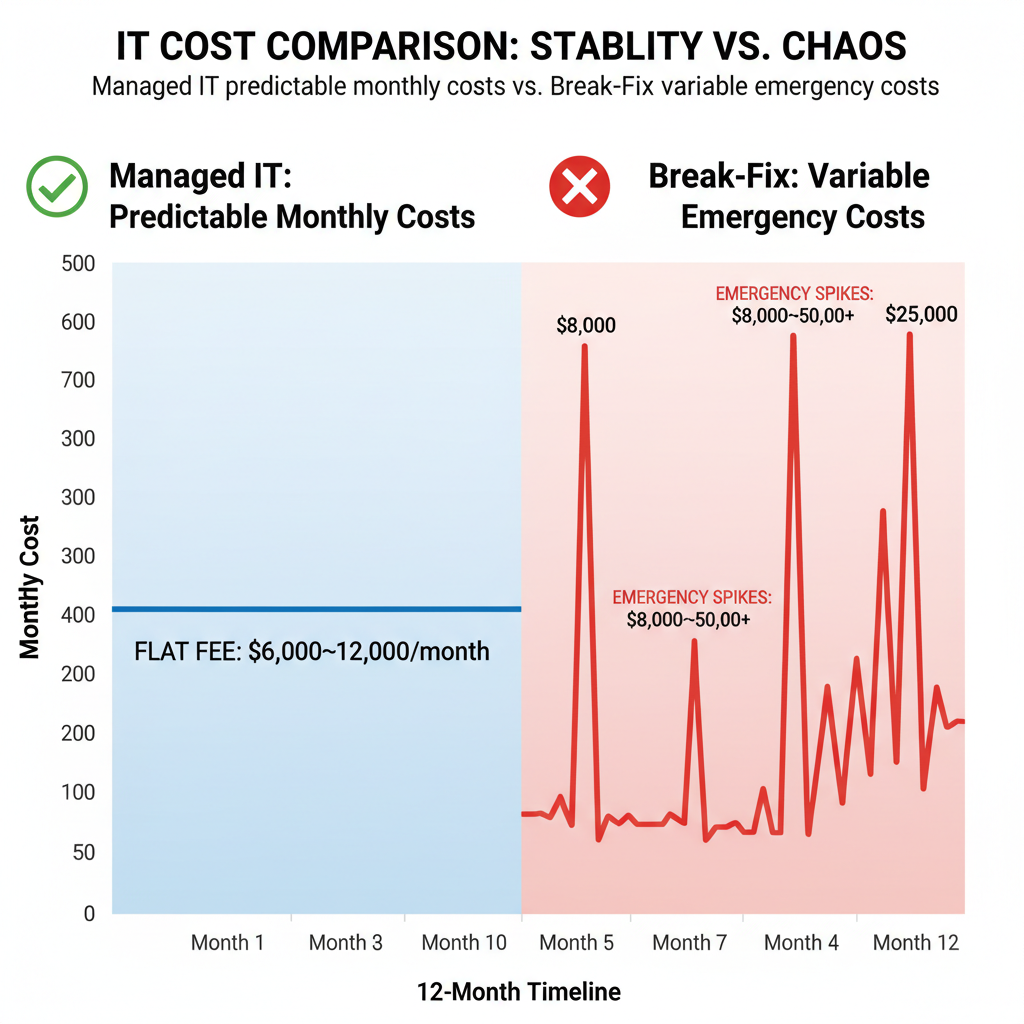
With managed IT (proactive), you pay a flat monthly fee of $200–$400 per seat for 24/7 monitoring, automated updates, and comprehensive support. In contrast, break-fix (reactive) means you pay only when something breaks—typically $150–$300 per hour plus parts, with no predictability.
For a 30-person law firm, managed IT costs approximately $6,000–$12,000 per month but prevents 60–80% of common IT issues before they impact your practice. Meanwhile, break-fix leaves you vulnerable to frequent outages. Consider this sobering reality: the average downtime cost for a law firm is $5,600 per hour. Ultimately, choose managed IT if compliance and uptime are non-negotiable. Otherwise, break-fix only works if you can afford frequent outages—and most law firms cannot.
This guide walks you through the key differences, real-world costs, and how to decide which managed IT vs break-fix model fits your firm’s needs and risk tolerance.
Cost Model: Managed IT vs Break-Fix – Fixed vs Variable
The financial structure of these two models tells the full story. Understanding the cost differences between managed IT and break-fix is essential to your decision.
Managed IT: Predictable Monthly Investment
Knowing exactly what you’ll spend each month is one of managed IT’s biggest advantages. For a 30-person law firm, budget $6,000–$12,000 monthly. This covers everything: 24/7 monitoring, patch management, antivirus updates, user support, and incident response.
As your firm grows, this predictability allows you to budget accurately and plan for expansion. Adding five people simply increases your cost proportionally—no surprises, no renegotiations. Furthermore, managed IT pricing scales linearly with your headcount.
Break-Fix: Unpredictable and Often Expensive
When you choose break-fix, you only pay when something breaks. However, this creates serious budgeting challenges. A simple router replacement might cost $500–$1,200 (parts + labor). Meanwhile, a network outage requiring emergency recovery could cost $5,000–$20,000. Then there’s ransomware—which can run $50,000–$500,000+.
One ransomware breach alone can cost more than three years of managed IT services. Consequently, break-fix leaves your budget exposed to catastrophic expenses. Therefore, predictability favors managed IT every time.
Real-World Cost Comparison: Managed IT vs Break-Fix
Consider what happened to a tax law firm in South Florida that relied on break-fix for five years. When ransomware struck during tax season, they faced:
- Emergency IT response: $8,000
- Data recovery services: $12,000
- Lost billable time (18-hour outage, 30 staff): $108,000
- Malpractice insurance surcharge (3-year impact): $7,200
- Client retention loss (estimated): $15,000
- Total damage: $150,400
Had they invested in managed IT at $8,000/month, their five-year cost would have been $480,000. However, that same ransomware attack would have been detected and stopped in real-time with zero downtime and zero recovery cost. In retrospect, the ROI on managed IT would have been immediate.
The lesson is clear: managed IT functions as insurance. Break-fix, by contrast, is gambling.
Response Time: Managed IT vs Break-Fix – Proactive vs Reactive
When it comes to law firms, response time is where the rubber meets the road. The speed difference between managed IT and break-fix directly impacts your billable hours and client satisfaction.
Managed IT: Issues Detected Before Users Notice
Through 24/7 monitoring, managed IT providers catch problems before they cascade into full failures. When an issue is detected—a spike in CPU usage, a failed backup, unauthorized access attempt—the security team investigates immediately. As a result, most issues are resolved before anyone in your firm realizes there was a problem.
Here’s a typical scenario: Your email server begins failing at 2 AM. Subsequently, managed IT detects it at 2:03 AM and restores from backup. By the time your first attorney checks email at 8 AM, everything is running normally. Zero impact. Zero billable time lost.
Break-Fix: You Call; They Come; Hours Pass
Without proactive monitoring, no one knows there’s a problem until users report it. Then you call your IT vendor. Typically, they respond when available—average wait time is 4–24 hours depending on severity and vendor capacity. In the meantime, your firm loses productivity.
During this delay, your attorneys cannot access case files. Furthermore, your paralegals cannot retrieve documents. Court deadlines continue approaching. Consequently, the cost of waiting compounds with every passing hour.
The Real Cost of Delay in Law
Consider what happens in discovery when a 2-hour email outage occurs during business hours:
- 8 staff members sitting idle
- $300–$600/hour per attorney × 2 hours = $1,800
- Paralegals at $100–$250/hour × 2 hours = $600
- Total lost billable time: $2,400+
Now multiply that by 3–4 unplanned outages per year (typical for break-fix firms), and you’re looking at $8,000–$10,000 in lost time annually. That’s nearly two years of managed IT service fees for a small firm. Additionally, this doesn’t even account for missed court deadlines or frustrated clients.
Compliance & Risk Management: Managed IT Standards
For law firms, compliance is non-negotiable. Here’s where managed IT and break-fix diverge dramatically. Understanding your obligations under FTC Safeguards Rule and ABA cybersecurity guidance is critical.
Managed IT: Compliance Built-In
Managed IT providers specializing in law firms include compliance monitoring and support as core services. Specifically, this includes:
FTC Safeguards Rule monitoring: The managed IT provider helps you maintain the “reasonable safeguards” required by the FTC. This involves regular security assessments, vulnerability scanning, and compliance documentation. Therefore, you’re audit-ready at all times.
Workstation Information Security Program (WISP) maintenance: A WISP is a documented policy required by the FTC. Subsequently, managed IT providers help you build and maintain it. Additionally, they ensure your WISP is tested and updated annually.
Audit readiness: When regulators or insurers ask for evidence of your security practices, managed IT providers maintain the documentation. Therefore, you can produce audit evidence within days, not weeks.
Email retention and legal holds: Finally, managed IT ensures emails are archived properly and can be retrieved for discovery. This is critical for law firms handling sensitive client matters.
Break-Fix: Compliance Is Your Problem
Break-fix providers typically do not address compliance. If you’re audited and the regulator asks, “How do you ensure your IT is secure?” you’re on your own to answer. This creates significant liability.
This creates several serious risks:
FTC violations: The FTC can fine $5,000–$50,000+ per violation. If your audit shows inadequate safeguards, break-fix is no defense. Moreover, fines have been increasing year over year.
Cyber insurance gaps: Many cyber insurance policies require evidence of reasonable security measures. Consequently, break-fix leaves gaps that insurers use to deny claims. Additionally, some insurers will not cover firms without managed IT.
Malpractice exposure: Should a breach occur and you cannot prove you took reasonable precautions, clients can sue. Therefore, managed IT documentation is essential liability protection.
Break-fix vendors often cannot even explain what compliance requires. They install antivirus and call it done. That’s simply not enough.
For law firms subject to FTC Safeguards or ABA guidance on cybersecurity, managed IT is not optional—it’s a requirement to meet your regulatory obligations.
Scalability & Growth: Managed IT Advantage
As your firm grows, these models handle scaling very differently. Understanding how managed IT scales is essential for long-term planning.
Managed IT: Linear Scaling
When you add one attorney to managed IT, your cost increases by one seat ($200–$400/month). Similarly, if you add five paralegals, your cost increases by five seats. The infrastructure, monitoring, and support scale with you seamlessly.
No hidden surprises emerge. No renegotiations are required. No bottlenecks slow your growth. Furthermore, your security posture remains consistent as you expand.
Break-Fix: Chaos at Scale
With break-fix, each new system becomes a new potential failure point. A 10-person firm might experience one outage per quarter. However, a 40-person firm with break-fix often experiences 3–4 outages per quarter because there are more systems, more users, more complexity, and no proactive monitoring.
Each outage requires emergency calls, emergency response, and emergency fees. Consequently, break-fix becomes exponentially more expensive as you grow.
Real example: A real estate law firm grew from 15 to 45 people over three years using break-fix. Their outages increased from 2 per year to 8 per year. Eventually, they switched to managed IT at 35 people because they could no longer absorb the downtime and cost. In retrospect, if they’d switched at 20 people, they would have saved an estimated $80,000 in emergency IT costs over that three-year period.
Security & Threat Detection: Managed IT Protection
The cybersecurity threat landscape is escalating rapidly. Moreover, law firms are prime targets because they hold valuable client data. Learn more about industry-standard security practices and why managed IT is essential protection.
Managed IT: Continuous Threat Hunting
Managed IT includes several critical security layers:
Endpoint Detection and Response (EDR): Real-time monitoring of all devices ensures that if ransomware attempts to spread, it’s detected and isolated within minutes. This proactive defense is impossible with break-fix models.
Dark web monitoring: If your firm’s data appears on the dark web, you’re alerted within hours, not weeks or months. Therefore, you can notify clients and take corrective action immediately.
Threat hunting: Security analysts proactively search for indicators of compromise (signs that attackers have been in your systems). Subsequently, threats are neutralized before they cause damage.
24/7 SOC (Security Operations Center): Trained security analysts review alerts and respond. Furthermore, they escalate critical threats to your managed IT provider within seconds.
Break-Fix: You React to Breaches After They Happen
Break-fix vendors do not hunt for threats. Instead, they install antivirus and hope nothing gets through. This reactive approach leaves you exposed.
If you do get breached, the consequences are severe:
- You may not know for weeks or months (average: 220 days industry-wide)
- By then, attackers have accessed client data, financial records, and case files
- You must notify clients, potentially face regulatory fines, and deal with malpractice claims
The 2024 legal industry average breach cost: $1.2 million in direct and indirect costs.
In contrast, managed IT detects most breaches within 24 hours. Early detection offers significant advantages:
- Attackers are contained before data exfiltration
- Minimal client impact occurs
- Lower breach notification costs result
- Potentially zero client data loss happens
For law firms, this distinction means the difference between managing an incident and managing a catastrophe.
Real-World Example – The $180K Downtime Incident
Before: Break-Fix Model
A 28-person real estate law firm in Fort Lauderdale relied on break-fix IT support. Their provider responded during business hours only (9 AM–5 PM). This created vulnerability.
In March, their file server crashed at 3:15 PM on a Friday. Unfortunately, their backup was outdated and incomplete (they later learned that the break-fix provider hadn’t tested it in 18 months). This is a common problem with break-fix models.
Files locked. No access. Weekend approaching.
They called their break-fix vendor. However, the vendor was already handling three other emergency calls that day. Consequently, response time: Monday morning. This delay cost them dearly.
For the entire weekend, they had no access to:
- Client closing documents
- Title search records
- Financial records
- Correspondence archives
Monday arrived. Emergency recovery began. Files were restored Wednesday (3 days of downtime). Three days of lost productivity and client dissatisfaction.
Costs incurred:
- Lost billable time (30 staff × 72 hours × $200/hour average): $432,000
- However, they only recovered 60% of that due to client cancellations and rescheduled closings
- Actual lost revenue: ~$260,000
- Emergency recovery service: $12,000
- Client apologies and relationship repair: ~$20,000 (estimated)
- Malpractice insurance surcharge (1.5% increase, 3-year impact): $7,200
- Total cost: $299,200
After: Managed IT Model
The same firm switched to managed IT in January of the following year. Immediately, their risk profile changed.
In April (same season, similar size firm), ransomware attempted to infiltrate their system at 2:47 AM via a phishing email. However, managed IT caught it immediately.
Here’s what happened:
- Email security system flagged the email as suspicious at 2:48 AM
- EDR agent on the attorney’s computer detected malware execution at 2:52 AM
- System automatically isolated the device
- Automated backup triggered immediately
- Security analyst reviewed and confirmed the threat at 3:10 AM
- All-clear was sent to leadership at 3:30 AM
- Firm was operating normally at 8 AM
Cost: $0 emergency response. Prevented loss: $300,000+. ROI: Immediate and undeniable.
That single incident paid for managed IT for 30 months. Furthermore, it prevented a potential malpractice claim and regulatory investigation.
The Verdict: Managed IT vs Break-Fix
Managed IT vs break-fix isn’t really a choice—it’s a question of which risk you can afford to take. The evidence overwhelmingly favors managed IT for law firms.
Break-fix works only if:
- You can afford 3–4 outages per year
- You can absorb $8,000–$50,000+ in emergency costs per incident
- You can afford compliance violations and potential regulatory fines
- Your clients will tolerate service interruptions
Most law firms cannot afford any of these risks. Therefore, managed IT is the only practical choice.
Managed IT works for firms that:
- Need predictable costs
- Cannot afford downtime during discovery or trial
- Take compliance seriously
- Want to sleep at night knowing threats are being monitored
For most law firms, managed IT is risk management. Ultimately, it’s insurance. And it’s the only model that allows you to scale safely. Additionally, it’s the only model that meets regulatory requirements.
The question isn’t whether you can afford managed IT.
The real question is whether you can afford not to have it.
Trust Signals
- 15+ years supporting South Florida law firms
- FTC Safeguards & ABA guidance certified
- Proven incident response (case studies available)
- Fortune 200 IT experience from our founders
- Dark web monitoring included with all managed IT services
- 99.9% uptime guarantee backed by SLA credits
Ready to Protect Your Firm?
If this resonates with your firm’s situation, let’s talk about making the move from break-fix to managed IT.
Learn more about our managed IT services for law firms, or schedule a 20-minute consultation to discuss your current IT setup, your compliance requirements, and what managed IT could look like for your firm.
No obligation. No sales pitch. Just honest assessment of your IT infrastructure and security posture.