
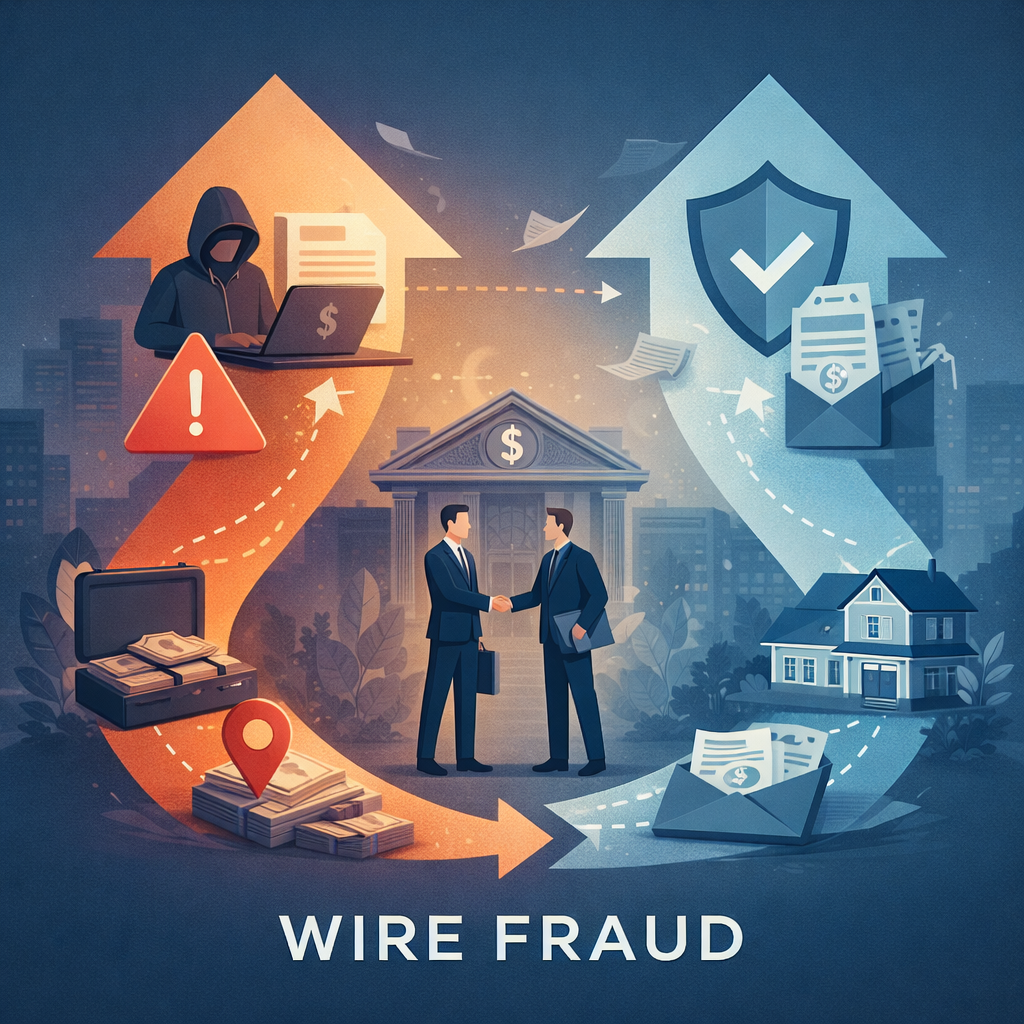
Wire fraud doesn’t happen because people are careless.
It happens because the process looks normal—until it isn’t.
Most title firm owners we speak with believe wire fraud is something that happens to other firms. The ones that weren’t careful enough. The ones that missed an obvious red flag. The ones that didn’t follow procedure.
The reality is far less comforting.
Wire fraud succeeds precisely because it blends into normal closing activity, exploits trust, and strikes at moments when speed matters more than skepticism.
A Real-World Scenario Title Firms Recognize
This is based on real cases we’ve seen—details changed, patterns intact.
A transaction is moving toward closing. Everyone involved has been communicating by email for days, sometimes weeks. Instructions have already been exchanged. Nothing feels out of place.
Then, shortly before funds are sent, an email arrives with “updated” wire instructions. The tone matches prior messages. The timing makes sense. The request doesn’t feel unusual.
The funds are sent.
Hours later—or sometimes days—the firm realizes the wire went to the wrong place. The account was controlled by a criminal. The money is gone.
No malware pop-ups. No suspicious links clicked. No obvious warning signs.
Just a normal day, until it wasn’t.
Why Smart, Experienced People Still Fall for This
Wire fraud is not a technical failure. It’s a process failure engineered by attackers who understand how title firms operate.
Criminals don’t rely on panic alone. They rely on familiarity, urgency, and credibility. They monitor email conversations, learn naming conventions, study timing, and wait for the moment when questioning a request feels inconvenient.
By the time the fraudulent instruction arrives, the attacker has already done the hard work. The firm is reacting inside a process that appears legitimate.
That’s why telling staff to “be more careful” doesn’t solve the problem.
How Wire Fraud Actually Happens
In most cases, the attacker gains access to email—either by compromising an account or convincingly impersonating a trusted party. From there, they observe quietly. No immediate action. No disruption.
They wait.
When the transaction reaches the right point, they introduce a change. Sometimes it’s subtle. Sometimes it’s framed as a last-minute correction. Often it looks exactly like what the firm expects to see.
Traditional defenses—antivirus, spam filters, even basic email security—often don’t catch this. There’s no malicious attachment. No obvious phishing link. Just a well-timed, well-written request.
By the time anyone questions it, the funds have already moved.
Why This Gets Worse Heading Into 2026
Everything about wire fraud is accelerating.
AI-driven impersonation is making emails, voicemails, and even phone calls more convincing. Attackers are better at mimicking writing styles, formatting, and tone. Fraud attempts are faster, more targeted, and harder to distinguish from legitimate communication.
At the same time, insurers, underwriters, and regulators are raising expectations. What was considered “reasonable” security even two years ago is already starting to look insufficient.
Controls that relied on trust, habit, or informal verification will not hold up in 2026.
What Actually Stops Wire Fraud
Wire fraud prevention is not about adding more technology for its own sake. It’s about designing friction into the right moments.
Effective firms treat wire instructions as high-risk transactions, regardless of who they appear to come from. Verification is done out-of-band, using known and documented contact methods—not replies to emails or numbers included in messages.
Access to email and financial systems is protected by strong identity controls. Multifactor authentication is enforced consistently, not selectively. Changes to wire instructions follow a defined process, not an exception made because “we’re busy.”
Most importantly, leadership owns the process. Staff are trained not just on what to do, but why it matters—and they are supported when they slow things down to verify.
This Is a Business Risk, Not an IT Issue
For title firm owners, wire fraud is not an IT problem you can delegate and forget. It’s a financial, legal, and reputational risk that sits squarely at the leadership level.
When a wire goes wrong, the question is rarely whether someone followed informal habits. The question is whether the firm had reasonable, defensible controls in place.
That standard is only going up.
Where to Start Without Disrupting Operations
You don’t prevent wire fraud by guessing where your weaknesses are. You prevent it by understanding how an attacker would see your firm today.
Which accounts are most exposed?
Where would an attacker wait?
What assumptions does your process rely on?
Which controls are missing, inconsistent, or informal?
A Cybersecurity Assessment helps answer those questions in a practical, business-focused way. It evaluates your current environment, identifies real-world risk—not theoretical threats—and provides clear recommendations tailored to how title firms actually operate.
No jargon. No scare tactics. Just clarity.
👉 Request your Cybersecurity Assessment here:
https://itfusiontech.com/free-network-assessment/
Because wire fraud doesn’t happen all at once.
It happens one “normal” step at a time—and stopping it requires intentional design, not blind trust.